
New York Bus Accident Attorney
Buses are on the road throughout New York state, from Manhattan to Albany, Rochester, and most cities in between. A crash happens in a matter of seconds yet can have a lifelong impact on its victims. You may qualify for a settlement if you sustained injuries in a bus accident.
The New York bus accident attorneys at Jacoby & Meyers, LLP, can help you pursue compensation for your damages. Call us today for a free claim evaluation.
Jacoby & Meyers, LLP, gets results for injured bus accident victims
The experienced legal team at Jacoby & Meyers, LLP, has represented accident victims throughout New York for 50 years. Individuals who suffer preventable bus accident injuries face great emotional and physical pain. Severe injuries and fatalities can devastate victims and their families while placing a significant financial burden on the household.
Our presence throughout all of New York state allows us the resources to investigate an accident and gather evidence to support a claim against the at-fault party. We relentlessly pursue the best possible outcome for each case.
The firm’s dedication to client service and professional excellence has led to the recovery of millions of dollars in damages for our clients. Our case results illustrate how we’ve successfully helped accident victims.
Some more recent examples of our results in New York traffic accidents include:
- $5 million for a client who was injured in a multi-vehicle crash
- $1.27 million for a client who was injured in a Bronx auto crash
- $740,000 after a client suffered injuries in an accident on the Brooklyn Bridge
- $525,000 for a client who suffered injuries in an accident when another driver ran a stoplight
- $475,000 for a child whose school bus driver ran over her foot
- $400,000 for a client who was injured when another driver ran a red light
- $247,000 for a client who was injured in a crash when the other driver was speeding
These are only examples of past cases and do not guarantee a particular outcome for your bus accident case. Each crash has specific factors that determine its values. The experienced bus accident lawyers at Jacoby & Meyers, LLP, have the resources to investigate an accident, gather evidence to support a claim against the at-fault party, and pursue the best outcome possible given an individual’s specific circumstances.
“If it were not for the integral legal team of experts at Jacoby & Meyers I would not be where I am today with my recovery. I highly recommend hiring Jacoby & Meyers should you ever find yourself injured in an accident, and an individual or company needs to be held accountable for their negligence.” -C.J.
★★★★★
Who is responsible for a New York bus accident?
We work hard to identify the negligent parties responsible for your preventable injuries. The law may hold one party or multiple parties accountable for a bus accident.
Bus driver
Bus drivers have an obligation to drive safely at all times. Their employers have trusted them to operate a vehicle weighing between 25,000 and 40,000 pounds. Preventable behaviors such as driving while under the influence of drugs or alcohol, eating, and using a cell phone can cause serious accidents.
Commercial bus companies
Depending on the nature of the accident, the law may hold the bus company responsible. Several commercial bus companies operate throughout New York:
- Greyhound Lines
- MegaBus
- Trailways
Commercial bus drivers may speed or take unauthorized shortcuts to meet their scheduled pick-up/drop-off times.
Private bus charters
Some New York residents hire buses for private excursions and parties. Some of the state’s charter bus companies include:
- Apex Coach
- Big Ben Transportation
- New York Charter Bus Company
- Omega Express
Smaller charter companies may have little oversight and “bend the rules” if they employ one or two drivers.
Local school districts
School districts across New York state provide bus transportation for students attending public and private institutions. These buses are on the road during the busiest times of the day, morning and afternoon rush hours.
Motor vehicle operators
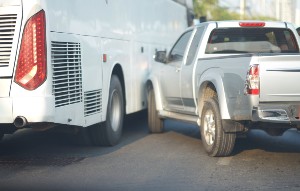 Preventable bus accidents can occur when other motor vehicle operators act negligently. Passenger cars and trucks may tailgate or cut in front of a bus. Serious accidents can happen when cars attempt to pass buses on the right side when passengers are loading and unloading.
Parts manufacturer or vendor
Defective and malfunctioning bus parts can interfere with the driver’s ability to handle the bus. Issues involving acceleration and braking, in particular, can cause an accident.
Bus maintenance firm
Buses, like all motor vehicles, require routine maintenance. The company that provides maintenance may be responsible for incomplete repairs or lapsed maintenance schedules.
Regional public transportation authorities
Numerous public transportation authorities operate throughout New York, including:
- Capital District Transportation Authority (CDTA) in Albany
- Metropolitan Transportation Authority (MTA) serving the NYC metro area
- Regional Transit Service (RTS) in Rochester
- Dutchess County Public Transit (Poughkeepsie area)
- Middletown Transit (Middletown)
These organizations have a responsibility to provide safe rides to their passengers.
3 Reasons you need a New York bus accident attorney
Handling a bus accident claim on your own is overwhelming. You are left vulnerable to the insurance company’s strong-arm tactics without legal representation. Here are three ways Jacoby & Meyers, LLP can help you with your claim.
Gather evidence
The cause of some bus accidents is readily apparent, while others require research. Our firm’s statewide presence and professional networks allow us to conduct investigations throughout New York. Our bus accident attorneys can take the appropriate legal actions to obtain video footage, question witnesses, and recreate the crash scene.
Handle insurance negotiations
Insurance companies primarily focus on their profits, not your recovery. Our lawyers can anticipate the strategies that insurance companies may use to devalue your claim. Let us handle negotiations with the insurance company so that you can focus on healing.
Represent you in court
Our skilled attorneys can negotiate adequate settlements without going to court. However, sometimes a trial is an appropriate option to maximize your compensation. We are trial attorneys who have experience with the local court systems.
Common causes of New York bus accidents
At Jacoby & Meyers, LLP, we conduct a thorough review to identify the cause or causes of your preventable injuries. Negligent behaviors on the part of the bus driver, bus owner, and the local municipality can all play a role in preventable accidents.
Bus driver negligence
Bus drivers can engage in unsafe behaviors while behind the wheel.
- Driving too fast for weather conditions. “Nor’easter” storms can create dangerous road conditions. Commercial bus drivers with a schedule to adhere to may drive too fast for snowy and rainy conditions. They may misjudge how much distance the bus requires to brake on slippery roads.
- Drunk or drugged driving. Drivers who operate any type of bus must obtain a commercial driver’s license (CDL). The Federal Motor Carrier Safety Administration (FMCSA) implements special regulations regarding drug and alcohol use for CDL holders. In addition to the FMCSA’s rules, most employers expressly prohibit the use of drugs and alcohol while on duty. Prescription drugs can also impair bus drivers and lead to dangerous accidents.
- Distracted driving. Bus drivers must stay focused on the road. Cell phone use, eating and drinking, talking to passengers, reaching for something on the floor, adjusting climate controls, daydreaming, and focusing on events outside of the bus can all lead to a preventable accident.
- Drowsy and fatigued driving. Driving without adequate sleep or not taking required rest breaks can be as dangerous. According to the FMCSA, 13 percent of commercial vehicle drivers involved in accidents were fatigued at the time of the crash. Bus drivers with night routes are especially at risk for drowsy and fatigued driving, as well as those with untreated sleep disorders.
- Speeding. Bus drivers must keep strict time schedules, so they may speed if running behind. The faster a vehicle travels, including buses, the more difficult it is for the driver to control.
Bus owner negligence
Negligence on the part of the bus owner or bus company can lead to accidents.
- Improper bus maintenance. Buses must be roadworthy. Failure to perform proper maintenance can lead to dangerous mechanical failures. Worn-out tires and failed brake systems are two common culprits that can lead to a bus accident.
- Improper hiring practices. Employers have a responsibility to hire competent and qualified bus drivers. A lack of training, too little oversight, and lapses in background checks can lead to unqualified bus drivers on the road.
Municipality negligence
Poorly maintained roads. The State of New York, its counties, and its cities are responsible for maintaining roads. This includes more than just patching potholes and clearing snow. Government entities are also responsible for fixing malfunctioning traffic signals, erecting traffic control devices where needed, and repairing fallen signs.
Special rules may apply when taking legal action against a government entity. If poorly maintained roads contributed to your bus accident, you should talk to a New York bus accident attorney as soon as possible to determine your next steps.
How much is my bus accident injury claim worth?
A settlement should compensate you for all of your accident-related damages. Personal injury law categorizes these damages as monetary and non-monetary.
Monetary damages in a New York bus accident
Monetary damages are also called economic damages and have an associated cost.
Your compensation should reflect your current and future monetary damages.
- Medical expenses. The cost to treat bus accident injuries adds up quickly, from the ambulance ride to diagnostic tests and hospitalizations. If your injuries require ongoing medical treatment, your settlement should reflect that.
- Lost income. Broken bones, internal injuries, and fractures can make it impossible to work. Catastrophic injuries like back injuries or traumatic brain injuries (TBIs) may cause permanent disability.
- In-home professional services. Injuries can prevent you from completing tasks you did before the accident. You may require temporary or permanent assistance with tasks like dressing, grooming, meal prep, housekeeping, child care, and lawn care.
- Replacement of personal belongings. A bus accident can damage your motor vehicle or bicycle. You may be able to seek compensation if the accident caused damage to personal belongings such as a laptop, medical device, cell phone, or jewelry.
Non-monetary damages
Bus accident-related damages that don’t have a set monetary value are called non-monetary or non-economic damages. The insurance company may attempt to undervalue or deny these damages because they are subjective.
We fight to ensure that your settlement reflects all the ways your preventable injuries affect your life and your family.
- Your pain and suffering. It may feel strange or even inappropriate to put a price on your physical pain and emotional suffering. However, the law entitles you to compensation for these “unseen” damages. Many bus accident victims feel a sense of closure when their settlement includes compensation for their pain and suffering.
- Post-traumatic stress disorder (PTSD). Bus and other motor vehicle accidents are a leading cause of post-traumatic stress disorder (PTSD). According to NewYork-Presbyterian Hospital, children and adults can experience PTSD. Symptoms may include anxiety, difficulty sleeping, wanting to avoid buses, and flashbacks of the crash. These symptoms interfere with daily life and can make it difficult—if not impossible—to attend school, work, and other obligations.
- Your family’s emotional distress. A bus accident can impact your loved ones, too. Your injuries can interfere with your relationship with your spouse and minor children.
Statute of limitations for New York bus accident injury claims
The time limit placed on bus accident injury claims is a statute of limitations. New York Civil Practice Law and Rules § 214 states that you have three years to pursue “an action to recover damages for a personal injury.” With few exceptions, the court will likely refuse your claim if you file after that deadline.
However, there is no reason to wait to consult our New York bus accident lawyers. Many forms of evidence disappear or deteriorate over time. Contacting us right away helps us gather evidence and build a strong case on your behalf.
NYC bus ridership statistics
Buses are a primary mode of transportation for many New Yorkers, especially those living in the five boroughs. The Metro Transit Authority (MTA) maintains statistics for bus ridership in the NYC metro.
These figures offer insight into how many people ride and share the roads with buses every day.
- Approximately 1.7 million people ride New York City Transit buses each weekday.
- The MTA Bus Company has just over 388,000 riders each weekday.
The five busiest bus routes in the New York City’s boroughs are:
- M15 Local/SBS (Manhattan)
- Bx12 Local/SBS (Bronx)
- B46 Local/SBS (Brooklyn)
- B6 (Brooklyn)
- B44 Local/SBS (Brooklyn)
The bus accident attorneys at Jacoby & Meyers, LLP represent bus accident victims throughout New York state.
Get Legal Representation After a New York Bus Accident
 The experienced bus accident attorneys at Jacoby & Meyers, LLP, are here to help you. Our personal injury lawyer team has the resources and dedication to build a strong case against the party or parties that caused your preventable injuries. If an out-of-court settlement isn’t in your best interests, we are willing to go to court to seek justice.
If you suffered injuries in a bus accident anywhere in New York state, you deserve compensation for your damages. Contact Jacoby & Meyers, LLP at (212) 445-7000 for a free case evaluation.
“If it were not for the integral legal team of experts at Jacoby & Meyers I would not be where I am today with my recovery. I highly recommend hiring Jacoby & Meyers should you ever find yourself injured in an accident, and an individual or company needs to be held accountable for their negligence.” -C.J.
★★★★★
Check out some of our other reviews.
Jacoby & Meyers, LLP
39 Broadway Suite 1910,
New York, NY 10006
(212)-445-7000